My week of travel through Morocco's High Atlas mountains and the Sahara desert was incredible, wonderful, and generally amusing. I went with three friends from my program, and we had a great time.

Saturday morning we hopped on a train to Marrakech (... and now you have Marrakech Express stuck in your head) and took a gran taxi to Imlil, a small mountain village that serves as a stepping-off point for many hikers in the High Atlas. My travel-mate Caitlin had yet another (serious) question as to whether she had any marriage prospects back in Alabama, this time from Abdu, our guide/host at the Imlil refuge. So of course, for the rest of the trip, we imagined Caitlin as a crazy American gone native in the High Atlas, married to Abdu with a hostel and a backyard full of baby goats.

Sunday morning we set out for the Toubkal Refuge, at the base of Jebel Toubkal, North Africa's highest peak. We planned to make the 5-6 hour hike to Toubkal, spend Sunday night at the base, hike Toubkal on Monday, and head back to Imlil Tuesday night. We left Imlil at 9:30 am and early into our hike we met a friendly British man who asked us if we had rubbers: "...what? -Rubbers? You know, waterproofs? For your feet. There's a meter of snow at the top, and 20 centimeters at the refuge!" Ah well, we figured, maybe it'll melt. On we marched.

En route we discussed what would be the perfect captions to our travels:

8 hours later, we plodded into the Toubkal Refuge, wet and freezing. It started to rain about half way through, and the altitude hit just after that. Then I remembered that I'd only ever gone on a few day hikes before, all at least 6 years ago, and started to ask myself why I thought that trudging up the side of a mountain would be "fun." Nevertheless, there wasn't anywhere between Imlil and Toubkal except for a few poorly stocked shops (which always had Snickers, thankfully) and a mosque, so we kept going. We got to the snow an hour and a half before we got to the Refuge, and by that point I had already decided that I would most certainly not be attempting to climb the summit.
The Refuge was over-priced and freezing cold inside and out (45 degrees in our room by 10pm), so Monday morning Zach and Caitlin (the best in shape and better equipped out of the four of us) hiked around the Refuge for a few hours, probably 1/3 of the way up the mountain, took some pictures, and at noon or so we headed back down to Imlil. The return journey took 6 hours or so, and through the course of those two days I decided that I didn't need to worry about not having exercised since getting to Morocco, because I had done more than enough in 34 hours to account for two months of laziness.

Tuesday morning we headed back to Marrakech, where I had the best Kefta a la Oeuf tagine I've had here (don't tell my host mom), spent the night in a youth hostel, and set off Wednesday morning for Ouarzazate.
In typical Moroccan fashion, our bus to Ouarzazate left the station an hour and a half late, drove into the middle of Marrakech, picked up 4 more people than there were seats for, drove back to the station, deposited some very angry and very vocal passengers at the station to wait for the next bus, and finally headed out for Ouarzazate. Ouarzazate was a very interesting city- it's home to one of the oldest kasbahs in Morocco, which set the scene for many a desert/arabian movie (Prince of Persia, Lawrence of Arabia, Gladiator), but wasn't a city before the French arrived. The French army built a barracks there to support their presence in the western portion of Morocco, and constructed a small city around the barracks. There are no French left, but the giant central square and wide boulevards lined in lamp posts attests to their presence. We also had a frustrating 1 hour search for ice cream, after being disappointed to learn that the bakery with a flashing ice cream cone sign hanging outside did not, in fact, serve ice cream. (Which may have been because it's now November, and the majority of Moroccans are regularly wearing heavy winter jackets, despite the fact that it's 73 degrees outside.)

From Ouarzazate we haggled our way through three gran taxis to get us to Risani, the town from which we departed for Merzouga, part of Morocco's Sahara. We were picked up by the desert tour guys, met with two friends, given a few hours in a local riad/hotel, and set forth into the Sahara atop a four wheel drive SUV (no really, on top of it, it was great). The tour guys dropped us off at the edge of our dunes, where a Bedouin guide and camels awaited us. We rode our camels into the bright orange sunset-lit desert and spent that night in tents, where it rained miserably. Our tent was covered in 'plastico' to prevent us from being wet in addition to coated in sand- I say plastico because our Bedouin guide spoke Berber, a little bit of Darija, a little bit of English, some Japanese, and Spanish almost fluently, so for the second time this semester myself and Ana did all of the communicating.

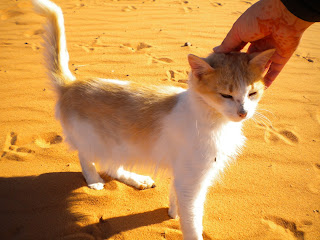
The next day we rode our camels to have tea with a Berber family (which normal Moroccans do all the time, it totally wasn't just for tourists), where I made friends with another Sahara cat. They all had dark amber eyes with black lids and rims to protect from the sun, and were incredibly friendly. Our guide explained that further in the desert they follow caravans and eat scorpions and other undesirable creatures, while where we were (closer to the edges) they eat birds, lizards, and tourists' food. That night we headed to an "oasis" (again, totally natural, definitely not just for tourists), played some Gnawa music, and took showers(!!!).
Friday morning we headed back into Risani for a tour of the city and mini-lesson on the different ethnic groups who've traded, moved, and settled through Risani over the years. Friday night we boarded a bus (same company) to take us to Meknes, where we'd get a train back to Rabat. After some seat-haggling with an angry old Moroccan woman, we were on our way. We stopped for a bit at a tiny town, where there were bathrooms and food, and kept trucking. We got into Meknes at 2 am, I fell out of the bus, we hopped on a train, and got into Rabat at 6 am.

It was a crazy crazy week, and I enjoyed all of it (eventually).

Saturday morning we hopped on a train to Marrakech (... and now you have Marrakech Express stuck in your head) and took a gran taxi to Imlil, a small mountain village that serves as a stepping-off point for many hikers in the High Atlas. My travel-mate Caitlin had yet another (serious) question as to whether she had any marriage prospects back in Alabama, this time from Abdu, our guide/host at the Imlil refuge. So of course, for the rest of the trip, we imagined Caitlin as a crazy American gone native in the High Atlas, married to Abdu with a hostel and a backyard full of baby goats.

Sunday morning we set out for the Toubkal Refuge, at the base of Jebel Toubkal, North Africa's highest peak. We planned to make the 5-6 hour hike to Toubkal, spend Sunday night at the base, hike Toubkal on Monday, and head back to Imlil Tuesday night. We left Imlil at 9:30 am and early into our hike we met a friendly British man who asked us if we had rubbers: "...what? -Rubbers? You know, waterproofs? For your feet. There's a meter of snow at the top, and 20 centimeters at the refuge!" Ah well, we figured, maybe it'll melt. On we marched.

En route we discussed what would be the perfect captions to our travels:
"All paths lead to Toubkal."
"Goddamnit Gretchen, why are you so good at Yahtzee?!"
"The path to Toubkal is paved in donkey poop."
"You need the nutrients."

8 hours later, we plodded into the Toubkal Refuge, wet and freezing. It started to rain about half way through, and the altitude hit just after that. Then I remembered that I'd only ever gone on a few day hikes before, all at least 6 years ago, and started to ask myself why I thought that trudging up the side of a mountain would be "fun." Nevertheless, there wasn't anywhere between Imlil and Toubkal except for a few poorly stocked shops (which always had Snickers, thankfully) and a mosque, so we kept going. We got to the snow an hour and a half before we got to the Refuge, and by that point I had already decided that I would most certainly not be attempting to climb the summit.
The Refuge was over-priced and freezing cold inside and out (45 degrees in our room by 10pm), so Monday morning Zach and Caitlin (the best in shape and better equipped out of the four of us) hiked around the Refuge for a few hours, probably 1/3 of the way up the mountain, took some pictures, and at noon or so we headed back down to Imlil. The return journey took 6 hours or so, and through the course of those two days I decided that I didn't need to worry about not having exercised since getting to Morocco, because I had done more than enough in 34 hours to account for two months of laziness.

Tuesday morning we headed back to Marrakech, where I had the best Kefta a la Oeuf tagine I've had here (don't tell my host mom), spent the night in a youth hostel, and set off Wednesday morning for Ouarzazate.
In typical Moroccan fashion, our bus to Ouarzazate left the station an hour and a half late, drove into the middle of Marrakech, picked up 4 more people than there were seats for, drove back to the station, deposited some very angry and very vocal passengers at the station to wait for the next bus, and finally headed out for Ouarzazate. Ouarzazate was a very interesting city- it's home to one of the oldest kasbahs in Morocco, which set the scene for many a desert/arabian movie (Prince of Persia, Lawrence of Arabia, Gladiator), but wasn't a city before the French arrived. The French army built a barracks there to support their presence in the western portion of Morocco, and constructed a small city around the barracks. There are no French left, but the giant central square and wide boulevards lined in lamp posts attests to their presence. We also had a frustrating 1 hour search for ice cream, after being disappointed to learn that the bakery with a flashing ice cream cone sign hanging outside did not, in fact, serve ice cream. (Which may have been because it's now November, and the majority of Moroccans are regularly wearing heavy winter jackets, despite the fact that it's 73 degrees outside.)

From Ouarzazate we haggled our way through three gran taxis to get us to Risani, the town from which we departed for Merzouga, part of Morocco's Sahara. We were picked up by the desert tour guys, met with two friends, given a few hours in a local riad/hotel, and set forth into the Sahara atop a four wheel drive SUV (no really, on top of it, it was great). The tour guys dropped us off at the edge of our dunes, where a Bedouin guide and camels awaited us. We rode our camels into the bright orange sunset-lit desert and spent that night in tents, where it rained miserably. Our tent was covered in 'plastico' to prevent us from being wet in addition to coated in sand- I say plastico because our Bedouin guide spoke Berber, a little bit of Darija, a little bit of English, some Japanese, and Spanish almost fluently, so for the second time this semester myself and Ana did all of the communicating.

The next day we rode our camels to have tea with a Berber family (which normal Moroccans do all the time, it totally wasn't just for tourists), where I made friends with another Sahara cat. They all had dark amber eyes with black lids and rims to protect from the sun, and were incredibly friendly. Our guide explained that further in the desert they follow caravans and eat scorpions and other undesirable creatures, while where we were (closer to the edges) they eat birds, lizards, and tourists' food. That night we headed to an "oasis" (again, totally natural, definitely not just for tourists), played some Gnawa music, and took showers(!!!).

Friday morning we headed back into Risani for a tour of the city and mini-lesson on the different ethnic groups who've traded, moved, and settled through Risani over the years. Friday night we boarded a bus (same company) to take us to Meknes, where we'd get a train back to Rabat. After some seat-haggling with an angry old Moroccan woman, we were on our way. We stopped for a bit at a tiny town, where there were bathrooms and food, and kept trucking. We got into Meknes at 2 am, I fell out of the bus, we hopped on a train, and got into Rabat at 6 am.

It was a crazy crazy week, and I enjoyed all of it (eventually).